Together We Act research: What the findings mean for cultural marketers
Together We Act research: What the findings mean for cultural marketers
By
Arts Marketing Association (AMA)
The Arts Marketing Association's Together We Act initiative has gathered insights from arts and heritage marketers across the UK, revealing how the sector is navigating three critical challenges: communicating in polarised times, adopting AI responsibly, and generating income under financial pressure. This research overview outlines the key findings.
Welcome / Croeso
Together We Act brings the cultural sector together to listen, learn collectively, recognise success and build shared responses to the challenges we face.
Thank you for sharing your thoughts through our sector survey, polls and 1:1 conversations with the AMA team. You have generously shared with us how you are overcoming challenges and we will build on this to identify how we can work together to ensure that arts and cultural marketers across the UK have the skills, knowledge and tools you need to thrive.
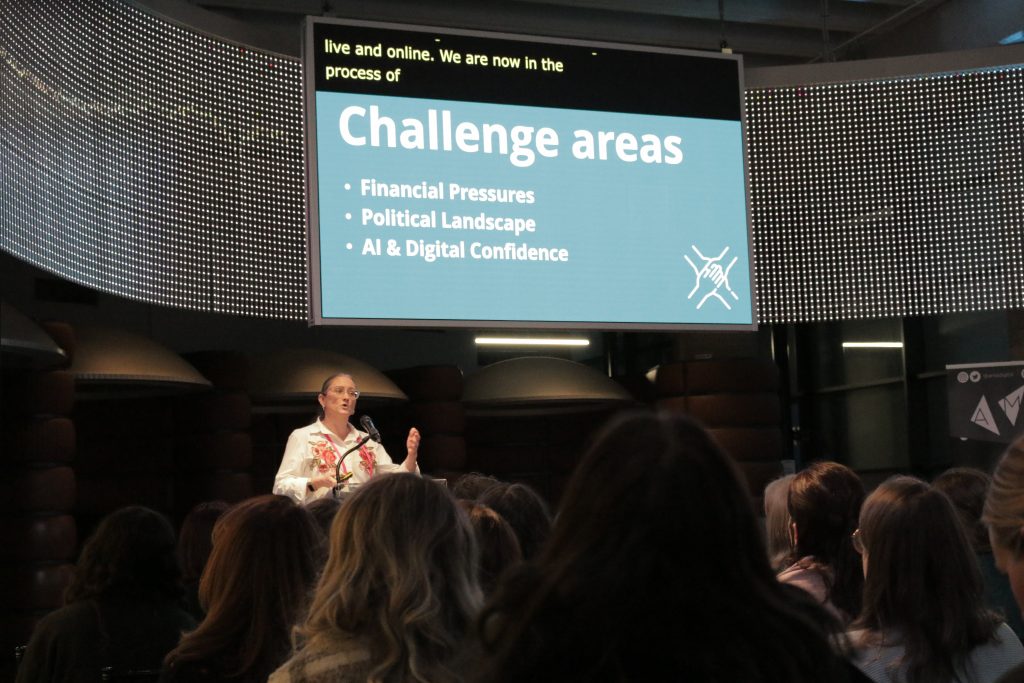
Together We Act focuses on three challenge areas that have been shaped by what you, our AMA members, have been telling us. They are:
1) Political Landscape: communicating in polarised times
2) Artificial Intelligence (AI) and Digital Confidence: exploring the ethics, risks and opportunities of AI and the skills needed to use it effectively
3) Financial Pressures and Income Generation: navigating higher targets with smaller budgets
Your responses make clear that organisations are working hard to balance the need to generate income against a strong commitment to access, equity and public value. Many of you have the skills and motivation to communicate confidently on complex and polarising issues but are often constrained by organisational caution and fear of backlash. Some of you are using AI to support stretched teams, but adoption is moving faster than shared understanding, ethical guidance and policy.
The following research overview kicks off the examination of the data we’ve gathered. Over the coming weeks we are going to be releasing deep dives into all three challenge areas as well as making space to discuss each one during our series of roundtable discussion events.
Insights in this report will shape our work over the coming year. We will bring together your expertise and experience to shape collective solutions and creative responses to enable us to accelerate past the obstacles of our uncertain context. Your involvement will be key to what happens next so that we can build what we need together.
Our sector, will only thrive if we continue to learn from one another, support one another and act with shared purpose.
Thank you very much /diolch yn fawr for your openness and your willingness to help shape the collective future of cultural marketing. We never take your support for granted.

Cath Hume, CEO, Arts Marketing Association (AMA)
Contents
The findings from the Together We Act research are split into the following sections:
Introduction
Common Themes
Challenge Area: Political Landscape
Challenge Area: Artificial Intelligence (AI) and Digital Confidence
Challenge Area: Financial Pressures and Income Generation
Next steps
Acknowledgements
Introduction
The Together We Act Sector Survey captured perspectives from 336 arts and heritage marketers and leaders working across all four nations of the UK. Respondents held marketing, communications, audience development, and leadership roles.
Respondents were from the full range of roles from assistants to managers and CEOs, to freelancers, board members and agency staff.
The survey explored current pressures, opportunities, and confidence levels across three key challenge areas informed by AMA members:
- Political Landscape including communicating publicly on polarising topics
- Artificial Intelligence (AI) and Digital Confidence
- Financial Pressures and Income Generation
Here is an overview of each area including some of the key findings. We’ll go into more detail on each of these challenge areas as Together We Act progresses.
We would also like to acknowledge that AI has been used in a supporting role when creating this overview to assist with qualitative data analysis. No personal or identifiable data has been shared with any AI large language models (LLMs) during this process.
Note on Freelancers
The role freelancers play in the cultural sector is fundamental. The Arts Marketing Association has long recognised and advocated the importance of freelance arts and heritage marketers to both our community and the sector. We want to be able to ensure we spotlight their views to the best of our ability.
Over 12.5% of respondents identified as a Freelancer / Consultant, so we’re keen to make sure we hone in on their views separately in a way that also features input from the 1:1 conversations we’ve been having with freelancers. We will be highlighting successes and concerns from freelancers in a research deep dive focused on their insights.
Common Themes
Some of the common threads across the three challenge areas include:
- High motivation, uneven confidence
Cultural marketers care deeply about their work and its impact, but often lack the structures, staff capacity, time, and resources to act with confidence.
- Values are strong, systems are fragile
The commitment to equity, access, and responsibility is widespread, but not always embedded in decision-making processes.
- Demand for practical support
Respondents are asking for tools, frameworks, examples of good practice, and peer learning – not abstract principles.
- A strong desire for collective action
Respondents want to learn together, move forward together, and share risk and responsibility.
Challenge Area: Political Landscape
Communicating in polarised times
Headline insight
The barrier is not skill or willingness of cultural marketers to communicate, but often organisational clarity and confidence.
Key findings
- Many respondents cite feeling personally capable of communicating on complex or polarising issues. 41% of respondents said they were ‘fairly confident’ or ‘very confident’ communicating with audiences on divisive topics
- Far fewer feel supported by their organisations to communicate on polarising issues.
- Emotional labour is often high for communicators, with this increasing further for staff from marginalised backgrounds.
- There is fear of backlash (particularly via social media) and this is significantly shaping decisions about whether and how organisations speak publicly.
- Respondents frequently cited:
- Board or senior leadership caution including a preference by boards for a neutral stance
- Unclear organisational positions
- Concerns about reputational risk
This creates a growing gap between stated values and public action, with marketing and communications staff often bearing the emotional and professional risk.
What’s working?
Respondents who feel more confident pointed to:
- Clear, values-led messaging grounded in organisational purpose
- Strong internal alignment on their organisation’s stance before going public
- Having scenario planning in place, and response frameworks agreed with leadership
- Leadership that visibly stands behind public statements when challenged
Summary
Overall, respondents have a strong desire for more collective responsibility rather than individual risk-taking. Many respondents are not asking to avoid difficult conversations; they are asking for the clarity, backing, and permission from their organisations to engage in them honestly and consistently. There’s a desire from some respondents for there to be less pressure to respond instantly on an issue and for more opportunity and time to think strategically. Some cite the need for board and leadership to increase their understanding and confidence in this area to be able to better support the marketing and communications function. While others feel that the communicators need to take the initiative and approach leadership.
Along with many respondents' expressing frustration at their organisations not willing to speak out on societal issues, there’s a strong contingent who believe organisations need to stay apolitical. Some are questioning whether their organisations should be speaking out at all, while others feel there can sometimes be an intolerance in the sector to views that differ from left-leaning thinking.
Challenge Area: Artificial Intelligence (AI) and Digital Confidence
Headline insight
AI adoption is already happening, but largely without shared frameworks, safeguards, or confidence.
Key findings
- Most respondents have experimented with AI tools, particularly for:
- Drafting copy
- Summarising information
- Supporting efficiency in small teams
- Helping to experiment and test new approaches
- Confidence levels tend to be basic to intermediate, with limited advanced or strategic use of AI. Knowledge is spread unevenly across organisational teams, and amongst those citing low confidence there’s a fear of ‘getting it wrong’. The most pressing concerns are not technical, but ethical and organisational with respondents mentioning the following as key issues for them:
- Bias and fairness
- Intellectual property and copyright
- Environmental impact
- Accountability when things go wrong
- Very few organisations represented by respondents currently have:
- Formal AI policies
- Clear guidance from their organisations on appropriate use
- Shared standards across departmental teams
- Council-run organisations have blanket policies in place that don’t allow employees to use AI within their work. A small minority have restricted employees to one platform such as Microsoft Copilot.
What’s working?
- Lots of efficiency gains for everyday tasks
Many respondents are successfully using AI to support everyday tasks such as summarising information, drafting first versions of content, and generating meeting notes. This is helping small, stretched teams and solo marketers save time.
- Using AI for low-risk experimentation
Respondents describe taking a cautious, trial-based approach to AI. They are using it as a starting point rather than a finished product and testing ideas before rolling it out more widely.
- AI building confidence for teams
Where AI is framed as a support tool rather than a replacement, respondents share feeling more confident in managing their workload and trying out new ways of working.
- Growth of peer learning
Informal sharing of tips, prompts and experiences between colleagues is helping marketing teams build understanding, even in the absence of formal guidance.
Respondents view AI as:
- Inevitable
- Potentially helpful
- Requiring careful implementation which aligns with values
- A threat to the cultural sector
- Unreliable and inconsistent
There is widespread uncertainty about where the boundaries should be on AI use, and who should be responsible for setting them.
Summary
The cultural sector is at risk of fragmented, inconsistent AI use without shared frameworks. Governance and understanding are lagging behind use. Responses suggest there’s a clear opportunity for the sector to shape responsible, values-led use of AI together along with collective guidance that balances innovative use with ethical, environmental and privacy considerations, as well as transparency.
Respondents who are against AI or reluctant users cite how they are grappling with existential questions in terms of jobs, threat to creativity, and undermining of the cultural sector’s credibility.
Challenge Area: Financial Pressures and Income Generation
Headline insight
Marketing teams are expected to deliver growth without proportional investment and within organisational structures where financial pressures are adding to leadership challenges and affecting decision-making processes.
Key findings
- The majority of respondents report ongoing or increasing financial pressure, driven by rising costs and constrained or uncertain income.
- Marketing budgets are expected to tighten further with 34.7% of respondents stating their marketing budget will stay the same over the next 12 months, while 21.84% of respondents said there would be a slight or significant decrease.
- Marketers are frequently expected to:
- Generate increased income
- Grow audiences
- Maintain access and inclusion
all without corresponding increases in budget, staffing, or time.
- Many organisations are caught between the need to raise ticket prices or commercial income, and staying true to their values such as affordability, equity, and access.
- Commercial innovation from other departments is occurring, but requires support from marketing teams without additional resources. This adds to already stretched workloads.
What’s working?
Successes shared by respondents included:
- Shifting focus to marketing organisational brand rather than individual events which is helping to build stronger audience relationships. This is stemming from improved data analysis, more personalised comms, and placing more emphasis on loyalty schemes and memberships.
- Introduction of dynamic pricing models helping to drive income while maintaining accessible tickets and organisational values. Respondents who didn’t universally like dynamic pricing, acknowledged its effectiveness for their organisations.
- Marketing teams are increasingly expected to justify their value as well as generate income. Many respondents describe spending significant time explaining the strategic role of marketing in financially constrained organisations, adding pressure at a time when capacity is already stretched.
Many respondents felt their successes were fragile, and very dependent on individuals rather than embedded in organisational structures for the long-term.
While some respondents shared that collaboration between different departments had improved, many felt that pressure was centred on marketing instead of programming and that there’s “a lack of understanding of marketing from other departments” and it’s often seen as “synonymous with social media”. It was acknowledged by some that the working relationship between marketing and programming departments could be closer to ensure sales targets align with artistic/exhibition costs.

Summary
There is a growing tension between income generation, and maintaining access, equity and audience value. More encouragingly there is a strong appetite for shared learning, realistic benchmarks, and practical income strategies that don’t undermine the core values and community-led aims of organisations.
Expectation management is becoming tougher to navigate with a growing disconnect between departmental teams, or between leadership and the rest of the organisation. This seems to be more common in organisations that are underperforming, or whose sales targets are being met but inflationary factors are affecting their ability to cover their costs.
Some cultural marketers acknowledged diversifying their income streams through activity within their remit or from being privy to organisational-wide conversations from the start. Others report having to contend with people from other departments coming up with new revenue streams which are decided on without marketers being in the room, but ultimately end up being added to already stretched workloads.
Next steps
We will be sharing additional deep dives into this research over the next few months. They will focus on each of the three challenge areas, alongside a deep dive on the intel shared by cultural marketing freelancers.
A series of Together We Act events will be taking place. This includes a series of lunchtime roundtable discussions for each of the challenge areas. Each session will share findings, case studies, and a provocation for you to discuss.
Join the conversation and share your thoughts in a safe space:
Financial Pressures and Income Generation
28 January 2026 | Online
Political Landscape - communicating in polarised times
11 February 2026 | Online
AI and Digital Confidence
4 March 2026 | Online
Acknowledgements
Produced by Arts Marketing Association

With special thanks:
To the 336 cultural marketers, leaders and freelancers who shared their thoughts and experiences in the Together We Act Sector Survey.
To the AMA members who have shared open and valuable insights with us during 1:1 conversations, AMA regional associates for giving us both your time and insights, and the AMA board members for sharing your experiences and for helping to inspire Together We Act.
Thanks to Ishreen Bradley and Mel Larsen for sparking this work through their research with cultural leaders for the Breakthrough programme.
Thanks to Art Fund, CultureSuite, Splitpixel, Ten4 Design and Tessitura for sponsoring Together We Act. Their support has made this research and upcoming events possible.




About the Arts Marketing Association
The Arts Marketing Association (AMA) is the UK's only membership organisation dedicated to supporting and advocating for the marketing community in arts, culture and heritage. It represents over 4,300 arts marketers and leaders in over 700 organisations, helping them develop their marketing expertise, inspire and connect with audiences, and thrive in their work.
AMA offers a regular programme of training, networking and events focused on new thinking and best practice. It also offers year-round access to sector resources including free intelligence resource hub, CultureHive.
AMA is an Investment Principles Support Organisation (IPSO) for Arts Council England and works across the UK with partners including Arts Council of Wales and Museums Galleries Scotland. Recent major project partnerships include The National Lottery Heritage Fund’s £4.2m Digital Skills for Heritage initiative and Arts Council England supported EDI organisational transformation programme Breakthrough, for cultural leadership teams.