
Together We Act Deep Dive: Political Landscape – communicating in polarised times
Together We Act Deep Dive: Political Landscape – communicating in polarised times
By
Arts Marketing Association (AMA)
A more detailed exploration of the qualitative data from Arts Marketing Association's Together We Act Research following on from the initial findings. It takes a deep dive into the qualitative data on communicating in polarised times plus a series of one-to-one conversations with AMA members from across the four nations of the UK.

Contents
Introduction
Headline
Findings
What’s working?
Ideas for new ways of working
Acknowledgements
About the Arts Marketing Association
Introduction
Together We Act is an Arts Marketing Association (AMA) initiative that brings the cultural marketing community together to share insight, listen to lived experience, and develop collective responses to the challenges we’re all facing.
This Together We Act Research Deep Dive follows on from the initial findings from the research. It’s a more detailed exploration of the qualitative data we’ve received from the Together We Act Sector Survey and a series of one-to-one conversations we’ve had with AMA members from across the four nations of the UK.
Together We Act has explored the current pressures, opportunities, and confidence levels across three key challenge areas informed by AMA members:
- Political Landscape including communicating publicly on polarising topics
- Artificial Intelligence (AI) and Digital Confidence
- Financial pressures and income generation
This first deep dive focuses on the Political Landscape challenge area. We asked cultural marketers and leaders about the challenges they are experiencing, strategics & tactics that are working for them, and their ideas on how we can better handle this work.
Respondents were offered the chance to select whether they would like their open-text responses to be quoted publicly. All responses are anonymous, but if respondents answered yes to this, they were offered the opportunity to select whether their art or heritage form and location were included.

Headline
The barrier is not skill or willingness of cultural marketers to communicate but often organisational clarity and confidence.
The above headline gives an idea of the sentiment that came out of the research, with 41% of respondents saying they felt ‘very confident’ (4%) or ‘fairly confident’ (37%) on communicating with audiences on polarising topics. This was compared with a total of 25% of respondents who shared that they were ‘not very confident’ (22%) and ‘not at all confident’ (3%). Still significant numbers who feel they lack confidence, but often this was connected to how supported they felt by their organisational policy and by leadership.

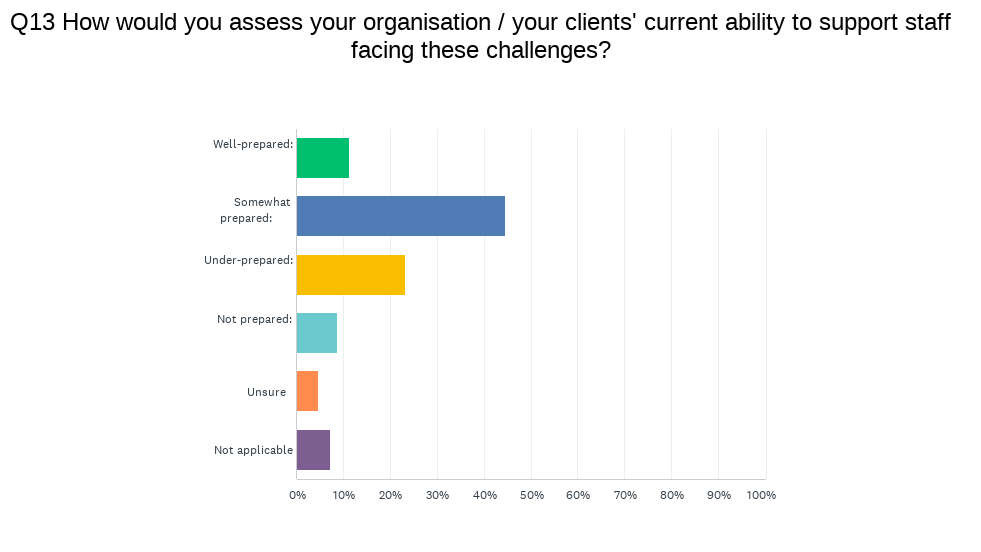
In contrast to the personal confidence, when asked how they would assess their organisation’s ability to support staff facing challenges on communicating on divisive topics, 32% respondents said their organisation was either ‘under-prepared’ (23%) or ‘not prepared’ (9%), while 44.5% felt they were ‘somewhat prepared’ by having some measures in place but with gaps still remaining in their provision. Only 11% of respondents said their organisation was ‘well prepared’ with clear policies, support systems and leadership backing.
Findings
This section explores the findings on Political Landscape in more detail along with directly sharing some of the responses we received.
From looking across all the responses, it’s apparent there’s a range of approaches and organisation dynamics which are impacting the confidence levels of staffing teams when communicating with audiences on divisive topics.
1) Many respondents said their organisations’ policy is not to comment on polarising issues.
Many respondents reported that their organisations were worried to speak out in case it jeopardises relationships with major funders, sponsors and other stakeholders. There’s a fear of getting things wrong and of backlash, particularly via social media, that could have impacts on reputation, ticket sales and other commercial revenue streams.
While lots are concerned about drawing media attention or creating an ‘internet pile-on’ for their organisation. This is shaping decisions on whether and how organisations speak publicly, with some actively avoiding posting to protect their teams, their organisations and their time.
Responses ranged from:
Tbh [to be honest] we do tend to avoid posting content that we feel will encourage unwanted comment/attention as it’s not worth it. - Respondent
We generally stay clear and/or follow industry consensus. - Service Provider Respondent in West Midlands
Less said, the better. - Respondent
Our current organisation has been avoiding public communications on topics outside of our organisation and branding. - Respondent
Many cite that their organisations are balancing standing up for social issues while ensuring they are not party political, they maintain neutrality and operate within Charity Commission guidelines. Others are having to juggle the need to meet funder and stakeholder expectations (including around Equality, Diversity and Inclusion) while maintaining a core audience who have differing views.
It's clear this is a pressing dilemma for many respondents:
Our stance in the past has been that we will stand up for social issues we believe in but are not party political; but it feels like this distinction is becoming harder to separate. - Respondent
Others are navigating changing political sentiment in their local communities that differs to their organisational values and mission.
An Arts Centre Respondent in North East England said: “The area we are in are quite right-wing and are against the communities we help.” while another commented that their “venue is based in an area which is already very polarised, with different communities living side by side, so often we will always be upsetting someone no matter what we say.”
While many are concerned that speaking out will harm their funding or affect their relationships with local authorities:
I think often we are most fearful of speaking out because it might upset a funder or the local council and put our organisation at financial risk.- Respondent
2) The stance of leadership and boards is often very different to the rest of staff teams.
There’s frustration expressed by many respondents that their organisations aren’t willing to engage on challenging topics and take a stance. Responses suggest a disconnect between the personal beliefs of staff, the stated values of organisation, and the action taken by their organisations publicly.
A respondent stated:
It's difficult to untangle the personal and professional in some instances. The decisions are ultimately made by leadership and the board, which doesn't reflect how the staff personally feel so it feels quite fraught.
There is a lot of anxiety internally about making any sort of public statement, as there is fear that this will be torn apart by the public. Additionally, our FOH [front of house] team have strong stances on topics which they feel we need to be shouting about - so my role feels like it's caught in the middle of two opposites. - Respondent
3) Internal communications and strategy appear to be lacking at many cultural organisations
An emerging challenge appears to be how best to define an organisational position when you’re navigating competing views internally on how that should be achieved. The majority of respondents cite a lack of clarity from leadership, while - as the above respondent shared - feeling like they are caught in-between different opinions, and having the pressure of navigating those expectations and internal politics. In many cases, responses indicate that internal communications needs to be improved to better understanding, break down silos and increase empathy between teams.
In lots of cases, respondents reveal they are looking for more guidance from senior leadership, but this isn’t forthcoming. Reasons vary from lack of understanding of communications, poor alignment between internal teams and a lack of forward-looking vision in terms of organisational strategy.
Many respondents demonstrate a dedicated passion for social change and a strong connection to the work of organisations and their values. Many of those same respondents express frustration with senior leadership for not taking a position on polarising topics. Though at the same time, it’s apparent that the level of disconnection between the external and internal sides of organisations varies.
Some organisations are communicating well internally but this isn’t mirrored by the views that are then shared publicly with audiences. Those who have cited internal comms as an organisational strength say it has led to successful comms processes being developed and given them confidence to speak on behalf of their organisations.
When asked about what was challenging for them, one respondent shared that it was:
Getting support from our Senior Management Team to do anything despite having an active Inclusivity and Diversity staff committee and being advocates for Equity. It’s all talk, no action. - Respondent
Another noted:
[It’s challenging] maintaining brand voice or statements not in agreement with my own views - Respondent
Some cite programming decisions that don’t always align with organisational values and impact on minority groups within staff teams. These decisions appear to create mixed messaging when the words and actions of organisations are not aligned.
An example of this challenge was shared by a Music/Orchestra Respondent in North East England:
Supporting staff from particular communities i.e. LGBT+ and trans community through difficult news and gov decisions - but then programming Harry Potter events.
While others have a preference to communicate their position through their programme rather than through organisational statements:
In the current climate our approach is often to communicate our position through programme rather than through public statements on social media, which we often find to be performative and divisive.- Respondent
4) Leaders are having to navigate unprecedented external pressures while also navigating internal pressures
Respondents who are organisational leaders or senior leadership team members have expressed the difficulties of managing the tension between the views of their staff teams and what the organisation is willing to take a position on.
Responses suggest a high emotional load for senior leaders and a lot of capacity being spent on navigating different opinions in their organisations:
There is immense pressure to make statements and simply resisting this can take a big emotional toll on the senior leaders (me!) who take this line.- Respondent
Managing the range of views internally, especially when staff see things very differently from stakeholders / donors. We are not always able to be fully transparent with staff about the complexity of funding sources/pressures. Staff sometimes have unrealistic expectations about how much it is possible / appropriate for us to investigate funding sources or comment on political issues. - Respondent
The pressures being shared by respondents (who are in leadership positions) suggests that better internal communication is needed in organisations so each department or staff group can better understand each other and the pressures each group are experiencing.
5) Some respondents questioning whether cultural organisations should be sharing their views.
There are respondents who have questioned the extent that arts and heritage organisations should be commenting on polarising topics. Themes raised include querying the relevance of their organisations speaking out on certain topics, some wanting to see a reduction in virtue signalling without action, and others expressing the view that arts should be for all of us.
Examples of this internal discussion includes a respondent expressing that they are “Debating whether we should be commenting at all and reflecting on our role as an arts organisation.”
A smaller group ponder questions around whether the cultural sector needs to better understand the views of those it doesn’t agree within order to better connect with communities.
A sector adjacent respondent in West Midlands said: “The sector as a whole tends to be left leaning (which is great and we fully support this) but sometimes is perhaps a little intolerant to views that differ/stray from this.” While a Science Centre respondent from South West England shared that it’s important to always try “to understand and pre-empt multiple viewpoints, particularly those that might not naturally align with our values.”
In contrast to the above, a minority express a less structured approach and are prepared to “just do it” in terms to putting out an organisational stance and then dealing with any reaction that follows.
6) Council-led organisations can get help from council staff, some experience hindrance.
There were a number of respondents from council-led or backed organisations where they either had this type of communication taken out of their hands – so any issues are passed straight onto the council’s in-house comms team, or they are bypassed altogether.
Others from council-led organisations spoke of the reassurance they felt from having the support of a dedicated comms team to assist and give advice. While other respondents shared that this relationship can hinder them as they have to wait a lengthy time for a response from council leaders.
Observations were shared that council-led organisations often have councillors from the local authority sitting on their board. These board members change when elections are held, and a new roster of local politicians can have an impact on how the organisation is communicating externally.
7) Marketing and communications staff are often bearing the bulk of the emotional and professional risk when communicating publicly.
The respondents who lead on communications have shared that they are expected to have all the answers by others in their organisations. There can be the assumption that they have all the detailed knowledge on nuanced topics required to make a strategic decision or comment.
This connects to expectation management across organisations and for many, a need for improved frameworks to be in place to give staff more confidence to speak on behalf of their organisations.
I think there's quite a lot of guilt and anxiety that comes with the politics of it all. I think the pressure as a marketing person, the pressure for brands and organisations to comment on political events feels really overwhelming, and when you're a tiny team where that is effectively just you is really difficult to manage. – Respondent from Festival
Many respondents suggest that a lot of this emotional baggage is unspoken, that this pressure is easily hidden especially for those managing social media channels. One respondent shared that they were “Not feeling supported. No understanding that this is coming into personal phones and devices, very little escape from it.” While another shared that “there’s a real duty of care not to rush to be responsive to online campaigning”. There appears to be strong sentiment from many cultural marketers that they would like to see social media better policed in terms of hate speech, while also feeling fatigue on having to use a lot of time moderating their channels:
I think it’s wearing on people. I there's a lot of anxiety about the way you phrase things but then also a lot of guilt that comes with feeling like maybe you're not being as bold as you'd like to be…because you're worried about pushback. - Respondent from Festival
Understandably, there's been a lot of focus on making sure customer-facing staff feel safe in the building, but consideration isn't always given to the impact that dealing with racist, bigoted messages and comments on socials has on members of my team. Even if they're largely blocking and deleting, it can feel quite relentless and upsetting. - Respondent
One respondent shared how their organisation wants them to just hide malicious comments as they feel that people who are trying to instigate an argument won’t be willing to engage in proper conversation.
This is a rationale that I understand, but as a large, visible arts organisation, do we not have a responsibility to call hate out when we see it? I'm not sure, this is just something I struggle with. As an East Asian person as well, it's a bit difficult to just take the abuse and swallow it, especially when it comes to racist comments.
What’s working?
Scenario Planning
Cultural marketers are reporting success where they have prepared as much as possible in advance of communications going live. They have workshopped multiple scenarios to pre-empt different audience viewpoints and know what they are going to say about a set topic in advance. For example, if a show or heritage event is on a specific topic, they have got a response ready ahead of it going live.
Policy and Processes
The respondents who were the most confident at handling communications on polarised topics cited having clear organisational policies and a clear communications matrix of which team members need to be involved, who key decision makers are during the process, who is communicating messaging, and information on timings and communication channels. Some reported that they have created FAQs or briefing sheets to support messaging both internally, externally and for in-person communication with audiences (e.g. box office or visitor receptions). While others make sure they have a plan in place on how to engage or not engage with any response their organisation gets. Other frameworks or processes that are working for respondents include:
- Tiered approach to escalation
- Using SWOT analysis during communications planning
- Triage system for negative comments
- Training for organisation staff on managing social media and comms challenges
- In-person dialogue with vocal and opposing groups of audiences (moving debate from social media to real people).
- Open forum for people to come and ask questions (both internal and external stakeholders)
- Identifying key spokespeople across the organisation and ensuring they have sufficient media training.
We have developed a policy on responding to world events, outlining our responsibilities as a charity as to what we can/cannot do to give organisational clarity. …support from all Directors [who are] being visible and accountable, is key. - Museum Respondent in Scotland
Referring back to your purpose
Respondents shared that referring back to their organisation’s charitable purpose or their ‘vision and mission’ helped them steer their communications. Organisations with brand clarity and well-embedded values reported feeling more confident in their approach.
We have a very clear brand and a robust set of values alongside our mission and vision. Being able to lean on the brand is incredibly helpful for me and my team. If people are unsure of whether or how to react, our brand can most often steer us in the right direction. - Respondent
Others had gained confidence as their organisations had set out the issues that they would proactively speak out on or champion. These tended to be issues that were either directly connected to their purpose or were evidenced within their work.
Whole organisation approach is key to consistency
Respondents who ensured that messaging was clear, concise and consistent across all aspects of the organisation reported success. They ensured everyone from trustees to senior leadership, marketing and communications staff, and front-of-house / visitor services were all speaking publicly as one unified voice.
Consistency is also referenced in terms of approach and ensuring transparency and openness with audiences and other stakeholder groups.
Listening is key
Lots of responses were on the importance of a ‘listen first’ approach. Success came when space was made to have the necessary calm and considered conversations, hearing different views and making time to acknowledge all standpoints. Many pointed to that being positive in building trust with both staff teams and external stakeholders.
A smaller group shared sentiment around the need during the listening phase to operate with the understanding that as a team or a community, we will not all agree, and acknowledging that’s fine.
Sentiment inferred by a Festivals respondent in Scotland:
Internally, being honest about the complexity of these issues and creating space for staff to share their perspectives has been essential, reinforcing that it’s okay for us to hold differing opinions while still working toward shared organisational values. While this approach doesn’t remove the difficulty, it reinforces trust and keeps artistic freedom at the centre of our communication.

Taking time
Many noted that they avoid being reactive and ensure they make time to speak with others in their staff team and community. This gives them space to digest and come up with a measured response if necessary. A large number of respondents felt it was vital to take time to process and sound out your strategy with colleagues and stakeholders. They suggest they’ve had more success when they haven’t tried to force solutions or a stance, and have given the situation time to breathe.
Taking time for self-care was referenced by some who said their organisations had therapy support from an external provider, while others shared that they had safeguarding policies to support both staff, creatives/educators and their audiences.
Getting input from people with lived experience
Respondents mentioned positive results from ensuring they had input from those with lived experience on a set topic, observing that it was vital in shaping knowledgeable and authentic messaging. A couple noted that they use distancing techniques when sharing lived experiences of their service users and participants.

Ideas for new ways of working
We asked respondents for their ideas, insights and thoughts on changes they would make at their organisations to better handle challenging communications.
Ideas shared included:
- Toolkits, frameworks, or a checklist to guide organisations through the response process alongside successful case studies.
- Tone of voice documents and both internal and external communications policies.
- A way of translating tough decisions from senior leadership into clear and ‘human’ words to support staff team’s understanding of decision making.
- Clearer guidance from senior leaders on what an organisation will or won’t address publicly.
- Organisational clarity on direction to build year-round messaging.
Deciding what we're tackling, and driving a narrative across the year. - Respondent
Evaluation ideas included:
- Brand tracking to better manage reputational issues and understand how taking a set position impacts your organisation.
- Cultural sector benchmarking
Support and networking ideas included:
- More shared guidance from sector bodies on best practice around polarisation, partnerships and activism.
- Network to anonymously discuss live situations and seek advice on best practice.
- A way of building confidence and getting staff members to feel more comfortable that some posts will attract criticism but can help to reinforce brand values.
A more unified sector stance [on polarising topics and partnerships] would help reduce individual organisational risk and give us a clearer framework to refer to publicly. - Festivals Respondent in Scotland
Acknowledgements
This deep dive is produced by
Arts Marketing Association 

With special thanks:
To the 336 cultural marketers, leaders and freelancers who shared their thoughts and experiences in the Together We Act Sector Survey.
To the AMA members who have shared open and valuable insights with us during 1:1 conversations, the AMA Connectors who gave both their time and perspectives, and the AMA board members who offered their experiences and helped to inspire Together We Act.
Thanks to Ishreen Bradley and Mel Larsen for sparking this work through their research with cultural leaders for the Breakthrough programme.
Thanks to Art Fund, CultureSuite, Splitpixel, Ten4 Design and Tessitura for sponsoring Together We Act. Their support has made this research and associated events possible.




About the Arts Marketing Association
The Arts Marketing Association (AMA) is the UK's only membership organisation dedicated to supporting and advocating for the marketing community in arts, culture and heritage. It represents over 4,300 arts marketers and leaders in over 700 organisations, helping them develop their marketing expertise, inspire and connect with audiences, and thrive in their work.
AMA offers a regular programme of training, networking and events focused on new thinking and best practice. It also offers year-round access to sector resources including free intelligence resource hub, CultureHive.
AMA is an Investment Principles Support Organisation (IPSO) for Arts Council England and works across the UK with partners including Arts Council of Wales and Museums Galleries Scotland. Recent major project partnerships include The National Lottery Heritage Fund’s £4.2m Digital Skills for Heritage initiative and Arts Council England supported EDI organisational transformation programme Breakthrough, for cultural leadership teams.