Report: Let’s Get Real AI
Report: Let’s Get Real AI
From April to December 2025 a group of 32 leaders and practitioners from 16 UK cultural organisations came together to experiment, learn and strategise around the use of artificial intelligence (AI) in their work. Let’s Get Real: AI was the twelfth iteration of The Audience Agency’s collaborative action learning and research programme.
Executive Summary
From April to December 2025 a group of 32 leaders and practitioners from 16 UK cultural organisations came together to experiment, learn and strategise around the use of artificial intelligence (AI) in their work. Let’s Get Real: AI was the twelfth iteration of The Audience Agency’s collaborative action learning and research programme.
This report details what we did, what we learnt and our recommendations for other cultural organisations looking to make sound ethical, strategic and practical decisions around how they might integrate AI tools and processes into their work. We don’t claim to have all the answers, but the insights from the experimentation, thinking and conversations these brave organisations undertook are relevant and useful for any arts or culture organisation grappling with AI’s complex challenges, risks and opportunities.
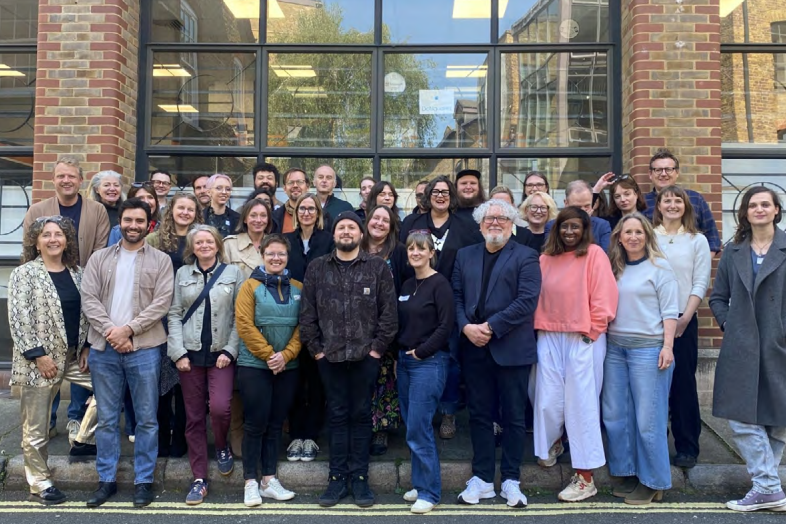
LGR:AI cohort, workshop 1, London, February 2025
The Let’s Get Real (LGR) programme encouraged a two-pronged approach - practical experimentation with an AI tool or process that either informs a new AI policy or puts an existing one to the test. We encouraged each organisation’s two participants to take ownership of either strategy or the practice. This combined practical and strategic nature of their experiments proved to be hugely significant, with the practical work generating insights and understanding that rippled out to impact strategic planning and thinking.
This symbiotic relationship between practice and strategy, and the shared experience of tackling such a complex and multi-faceted topic, unlocked new learning for many of us. Participants’ feelings about AI at a personal and societal level, as well as in the context of their organisations, were the bedrock and starting point of the programme. Feelings on AI run deep and were often seemingly conflicted - many of us felt both scepticism and optimism; fear and excitement; or caution and openness, at the same time. We acknowledged and held those dualities throughout the process, as a healthy tension.
Three key themes emerged across the 16 sets of experiments - Emotions and people-centred practice; Experimentation, guardrails and strategy; Technological and data readiness. The considerations within those themes, coupled with the experimental case studies detailed from page 33, informed our five recommendations for cultural organisations navigating AI:
01/ Ensure processes are people-centred, not led by AI
02/ Create clear guardrails that can flex and evolve as AI tools and context change
03/ Nurture small-scale, low-stakes experimental approaches
04/ Strengthen your data before scaling your use of AI
05/ Learn with peers and share knowledge
The cultural sector is not alone in wanting to ensure our adoption of AI is responsible, ethical and ultimately purposeful. In many ways, issues around AI such as the domination of Big Tech, the need for ongoing skills-building, the financial pressures, and so on, are not new, and not different from the wider digital transformation challenges.
In terms of speed, scale and potential impact though, AI is different. The environmental cost, the damage being wrought by baked-in bias within large language models and the risks to the creative arts posed by generative AI are just three hugely significant challenges not yet fully understood and addressed. This scale of change and widespread integration of AI into the tools and platforms we use every day, mean AI cannot be ignored. The cultural sector needs to urgently find its collective voice and be part of the conversation.
This LGR programme has barely scratched the surface of those huge questions. Our findings are constructive and relevant, but we know there
is a long way to go. Next time around, we will dive deeper, looking into the potential social value and impact of using AI in cultural organisations, whilst still asking the hard ethical questions.
Developing the digital confidence and literacy of cultural leaders and practitioners, with a focus on AI, is imperative for our sector and wider society. This means digging into people’s emotions, listening to different views, discussing the ethics and arriving at a shared understanding that is holistic, purposeful and contextual and an ethical, responsible approach to AI.
Let’s Get Real: AI was collaboratively funded by participating organisations. Our partners were Jocelyn Burnham and University of Leicester’s Institute for Digital Culture. The programme was kindly supported by Bloomberg Connects and Arts Marketing Association (AMA).
Download Let's Get Real: AI (PDF)